

Security policy

Delivery policy

Return policy
ETL Systems TLT-D-K4KX-1024 Ka-Band Test Loop Translator 27.5–31 to 17.3–21.2 GHz
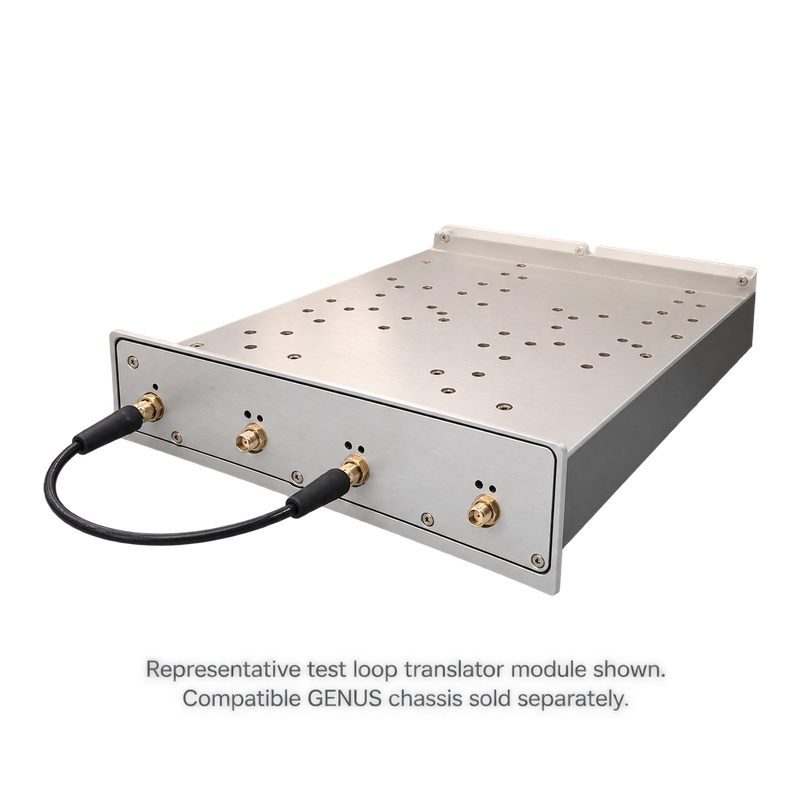
The ETL Systems TLT-D-K4KX-1024-K5K5 is a Ka-band-to-Ka-band test loop translator module for satellite communications test systems. Four selectable conversion modes cover input frequencies from 27.5–31 GHz and output frequencies from 17.3–21.2 GHz without spectral inversion.
The module provides 1 GHz instantaneous bandwidth and a synthesised local oscillator with 1 kHz steps. Input and output frequency settings are user controllable. Gain accuracy and flatness specifications apply only to the mode frequencies listed below.
Attenuation is adjustable from 0 to 60 dB in 0.25 dB steps, with a specified step tolerance of ±0.20 dB over the operating band. Conversion gain is 0 ±3 dB at the 0 dB attenuation setting. The module also provides an 80 dB mute function.
The hot-swappable module occupies eight slots in a compatible GENUS 1U chassis. The manufacturer specifies one translator module maximum per chassis. Local touchscreen and remote monitoring and control are provided through the compatible chassis platform.
Specifications
Model: TLT-D-K4KX-1024
Full Model Number: TLT-D-K4KX-1024-K5K5
Product Type: Ka-band-to-Ka-band test loop translator module
Input Frequency Range: 27.5–31 GHz across four selectable modes
Output Frequency Range: 17.3–21.2 GHz across four selectable modes
Instantaneous Bandwidth: 1 GHz
LO Frequency Control: 1 kHz steps; user-controllable input and output frequency settings; performance qualification below
RF Ports: 50Ω 2.92 mm input and output
Conversion Gain: 0 ±3 dB at 0 dB attenuation; specified mode frequencies only
Attenuation Control: 0–60 dB; steps of 0.25 ±0.20 dB over the operating band
Maximum Input Level: 0 dBm operational; +20 dBm absolute maximum for no damage
Gain Flatness: ±3 dB full band; ±2 dB over any 1 GHz; ±1 dB over any 500 MHz; ±0.5 dB over any 40 MHz; specified mode frequencies only
Input / Output Return Loss: 14 dB typ.; 10 dB minimum for both
Internal Reference Stability: ±0.05 ppm over 0°C to +50°C
External Reference Input Level: +3 ±3 dBm
Mute / Spectral Response: 80 dB mute suppression; non-inverting conversion
Chassis Compatibility: GENUS 1U; eight slots per module; one translator module maximum per chassis
MTBF: Greater than 80,000 hours per module
Selectable Conversion Modes
| Input Frequency Range | Output Frequency Range |
| 27.5–28.5 GHz | 17.3–18.3 GHz |
| 28.5–29.5 GHz | 18.3–19.3 GHz |
| 29.5–30.5 GHz | 19.2–20.2 GHz |
| 30–31 GHz | 20.2–21.2 GHz |
Only one mode is selectable at a time, and the input and output must use the same mode. Input and output frequency settings are user controllable, but gain accuracy and flatness specifications are valid only for the listed mode frequencies.
Phase Noise
| Offset | Phase noise, typ. |
| 100 Hz | −70 dBc/Hz |
| 1 kHz | −75 dBc/Hz |
| 10 kHz | −80 dBc/Hz |
| 100 kHz | −85 dBc/Hz |
| 1 MHz | −100 dBc/Hz |
Key Features
• Four selectable Ka-band conversion modes.
• 1 GHz instantaneous bandwidth.
• Synthesised LO with fine 1 kHz frequency adjustment.
• 60 dB variable attenuation.
• 50Ω 2.92 mm RF connections.
• Non-inverting frequency conversion.
• Hot-swappable module with chassis-based local and remote control.
This listing covers one TLT-D-K4KX-1024-K5K5 translator module. The GENUS chassis, external reference source, RF cables, and other accessories are sold separately unless included in the quoted configuration. Touchscreen, Ethernet, SNMP, web interface, and redundant power features depend on the selected chassis configuration.
The manufacturer specifies one translator module maximum per chassis. The full input and output ranges are covered through selectable modes and are not simultaneously available as instantaneous bandwidth. The V2.1 datasheet describes a chassis-based internal 10 MHz reference and external reference injection with automatic detection; confirm external reference requirements for the selected chassis. The reference stability temperature range is not a complete module operating-temperature specification.
